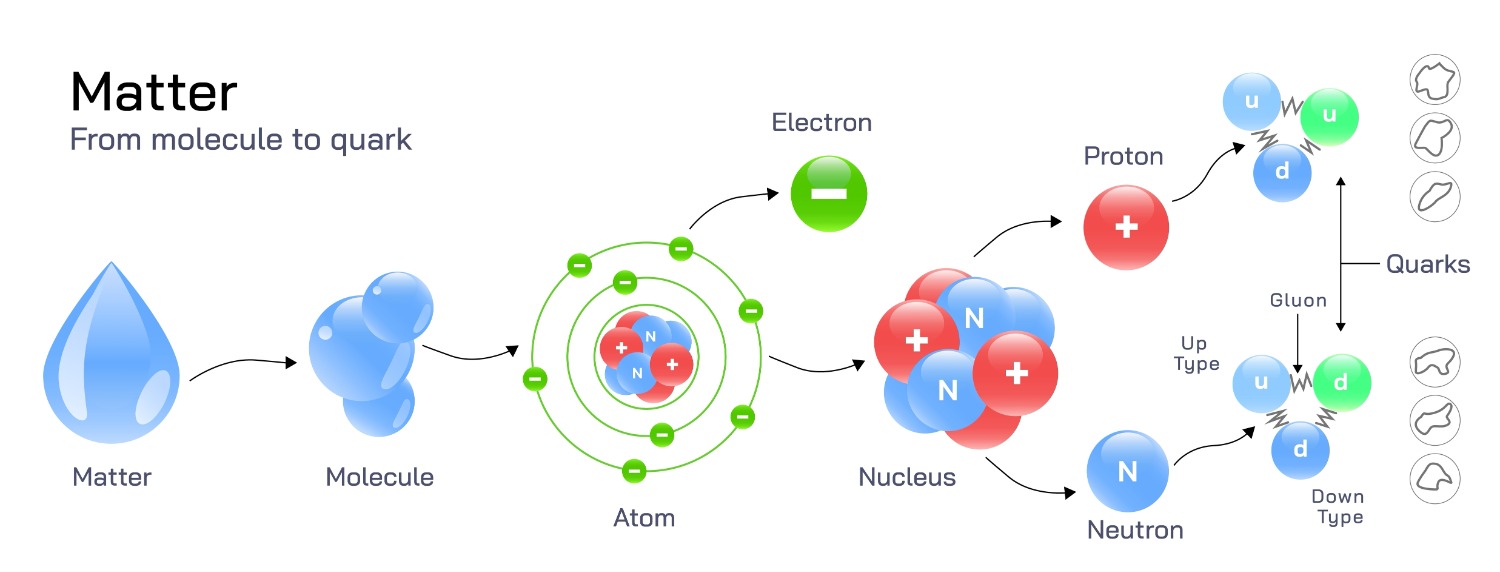
Mass Flow Measurement
The World Market for Mass Flow Measurement
Shipping in July 2026
Flow Research is now creating a first-ever mass flow study, The World Market for Mass Flow Measurement. Our goal is to paint a comprehensive picture of the entire mass flow market. While the majority of flowmeters measure volumetric flow, three types of flowmeters measure mass flow directly: Coriolis, thermal, and multivariable flowmeters. Another type, mass flow controllers (MFCs), both measure and control the flow. MFCs are used in the semiconductor industry as well as in industrial markets.
The upcoming, executive-level study is based on 2025 data on mass flow controllers and Coriolis, thermal, vortex, and differential pressure (DP) flowmeters — including multivariable technologies. It explores the reasons for measuring mass flow, and then looks at the advantages and disadvantages of Coriolis, thermal, and multivariable flowmeters.
This study will determine the size of the entire mass flow market in 2025 and forecast market growth through 2030. Segmentation will include total worldwide market size broken down by eight geographic regions and the basic mass flow technology types: Coriolis, thermal, MFC, and multivariable flowmeters.
The study has multiple objectives:
• Show worldwide market size and shares for the mass flow market in 2025 for Coriolis, thermal, MFC, and multivariable flowmeters
• Forecast mass flow market growth through 2030
• Share top-level data about each of the types
• Segment data both on a worldwide basis and for each of eight global regions
• Discuss market forces and suggest strategies for selling into the mass flow controller market
Why measure mass flow?
While in many cases volumetric flow is sufficient, it is also desirable at times to measure mass flow. Many products are sold by weight rather than by volume, and in these cases it is often desirable to measure mass flow. Chemical reactions are often based on mass rather than volume, so mass flow measurement is often required in the chemical industry.
While both volumetric and mass flow apply to liquids and gases, mass flow is especially appropriate for measuring gases. This is because gases are much more affected by temperature and pressure than are liquids. Pressure has minimal effect on liquids in terms of compressibility and is often ignored in making volumetric measurements of flow. The effects of temperature on liquids are also often disregarded, except where high accuracy is desired.
Coriolis flowmeters
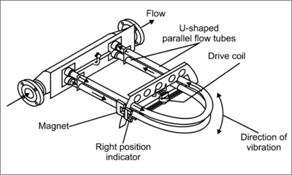
Coriolis flowmeters use fluid momentum to measure mass flow directly. The fluid enters the meter and passes through one or more vibrating tubes and accelerates as it reaches the point of maximum vibration. As the fluid leaves this point, it decelerates. This causes an oscillating motion in the tubes. The Coriolis meter measures this oscillating motion, and mass flow is directly proportional to the amount of oscillation.
Coriolis flowmeters are the most accurate meters. Their main limitations are line size and cost. Over 67 percent of Coriolis flowmeters are used on line sizes of two inches and less. Coriolis meters become very large and unwieldy, especially in sizes above four inches. Cost also increases with size. Even smaller size meters are generally more expensive than other comparable new-technology flowmeters. Users who are considering Coriolis flowmeters need to balance their need for accuracy and reliability against purchase price. Some users select Coriolis meters despite their higher initial cost, because low maintenance requirements reduce their cost over the life of the meter.
The high accuracy of Coriolis meters – up to 0.05 percent – is one of the major reasons for their continued growth. Companies that need flowmeters for custody transfer, or want highly accurate measurements in terms of mass, have good reasons to select Coriolis flowmeters. They find that despite a relatively high price tag, Coriolis flowmeters can provide a good return on investment.
Thermal flowmeters
Thermal flowmeters are among a small group of fluid measurement technologies that can generate a mass flow measurement independent of additional component technologies. Mass flow data is generally considered more useful than volumetric data for many applications – such as custody transfer of hydrocarbon fluids – and can offer higher repeatability, a level of measurement certainty highly valued by process and quality control managers alike.
Thermal flowmeters measure mass flow quite differently from Coriolis flowmeters. For example, instead of using fluid momentum as Coriolis flowmeters do, thermal flowmeters make use of the thermal or heat conducting properties of fluids to determine mass flow. While most thermal flowmeters are used to measure gas flow, some also measure liquid flow.
In contrast, other flowmeter types that can also produce a mass flow result do so with the addition of pressure and temperature sensors. Mass flow is then computed from the volumetric flow, and the temperature and pressure variables. Multivariable differential pressure and vortex flowmeters can both be used in this way to compute mass flow.
Mass flow controllers (MFCs)
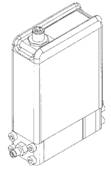
Mass flow measurement, which measures the mass of a fluid independent of pressure or temperature, is more reliable and offers a higher accuracy and repeatability than volumetric flow, which measures the volume of a gas or liquid occupying a pipe. This difference is particularly important for gases, which shrink or expand in volume with changes in pressure or temperature, but whose mass – the number of molecules – stays constant.
Fortunately, a mass flowmeter can easily provide flows in volume by adding the volume (including the pipe diameter) to the calculation. Conversely, some volumetric flowmeters e.g., multivariable vortex and differential pressure flowmeters – can indirectly provide mass flow by also measuring temperature and pressure and computing the mass flow.
MFC technology types are thermal, pressure, Coriolis, and ultrasonic. Because MFCs are used both to measure and to control fluid flows, the study will identify their use by fluid type. We will also quantify the presence of MFCs in significant industries and applications, including semiconductor and industrial.
Advantages of multivariable flowmeters
Multivariable flowmeters measure mass flow by combining volumetric flow measurement with density measurement. Density is usually measured either by consulting a table, or by dynamically measuring pressure and temperature. This is called an inferred method, because a formula is used to compute mass flow. The main types of multivariable flowmeters are differential pressure (DP), vortex, and ultrasonic.
One main advantage of multivariable DP flowmeters is that only one process penetration is required to get three process readings: flow, temperature, and pressure. This reduces the chance of fugitive emissions, and also the number of leak points. Another advantage of multivariable DP meters is that users who are already measuring volumetric flow with a DP flowmeter can upgrade to a multivariable DP meter with a minimum of changes.
One disadvantage of multivariable flowmeters is that accuracy levels are not as high as accuracy levels of Coriolis meters. This is due to the number of variables involved, and to the fact that it is an inferred method of computing mass flow. On the other hand, the purchase price of multivariable flowmeters is substantially below that of most Coriolis meters.