
The World Market for Magnetic Flowmeters, 8th Edition
We are excited to announce that The World Market for Magnetic Flowmeters, 8th Edition, began shipping in March. Spoiler alert: The study revealed not only that magmeters generate more revenue in the process industries than any type of flowmeter, but they also sell the most units. This came to light because for the first time we looked at the compound annual growth rate (CAGR) for all flowmeter types from 2002 and 2022 (and included this data for Coriolis, ultrasonic, and magmeters in the study). This comprehensive new 8th edition builds and expands on earlier editions in 2001, 2003, 2005, 2009, 2015, 2017, and 2022 and provides:
- Worldwide supplier market size and shares for magnetic flowmeters in 2025
- Market shares for the leading suppliers of magnetic flowmeters worldwide
- Growth forecasts for magnetic flowmeters by multiple segments through 2030
- Segmented data on a worldwide basis and for 9 regions
- Product analyses for the major suppliers
- Industries and applications
- Market and product strategies
- Company profiles
- Bonus: Coriolis, ultrasonic and magmeter market size and growth rates by units and revenue from 2002 to 2020
New developments
Magnetic flowmeters have been around longer than any other new-technology flowmeter. The Tobinmeter Company first introduced magnetic flowmeters for commercial use in Holland in 1952 and Foxboro introduced them to the United States two years later. This puts their time of introduction well before that of other new-technology flowmeters, including Coriolis (1977), ultrasonic (1963), and vortex (1969). Consequently, magmeters have had more time to penetrate the markets in Europe, North America, and Asia. Today more than 60 suppliers worldwide offer magmeters.
While the magnetic flowmeter market is a mature and stable one, some new product developments favor continued growth.
One recent development is the advent and increasing popularity of two-wire magmeters. Four-wire meters have a dedicated power supply. Two-wire meters use the power available from the loop-power supply, reducing wiring and installation costs. While two-wire meters still represent only a small percentage of the total magnetic flowmeters sold, their use continues to grow.
Another important development is battery-operated and wireless magnetic flowmeters. Battery operated meters make it possible to install magmeters in hard-to-reach places. And wireless meters can transmit a receivable signal where the use of wires is impractical. Both of these segments represent fast-growing areas of the magnetic flowmeter market.
Another recent development in product types is the trend toward lower-cost, compact magnetic meters in the United States. Compact meters have traditionally outsold remote meters in Europe, while the reverse has been true in the United States. While compact meters may be losing some ground to remote meters in Europe, they still dominate that market.
Our comprehensive study includes these and other highlights:
- Liners — the “secret sauce” of magnetic flowmeters
- Improvements in magnetic flowmeter technology
- The development of two-wire and battery-powered magnetic flowmeters
- The demand for 2-wire, 4-wire, and battery-powered meters
- The need for insertion magnetic flowmeters
- Most frequently used line sizes
- The installed base of magnetic flowmeters
Why are magnetic flowmeters so popular?
In addition to a large installed base, magmeters have many advantages that help account for their role as the leading revenue-generating flowmeter:
Highly accurate with no moving parts: Magnetic flowmeters are highly accurate, do not create pressure drop, and can be used for custody transfer applications. Magnetic flowmeters do not have moving parts and provide a highly stable measurement. Their initial purchase cost is medium to high, depending on size. While their price is generally higher than DP flowmeters, most are priced lower than equivalent Coriolis meters. In addition, advanced diagnostics are making magmeters both more intelligent and more reliable.
Do especially well in the water and wastewater industry. Most flowmeters do their best work in clean liquids or gases. Magnetic flowmeters, by contrast, thrive on dirty liquids. They are used to measure the flow of conductive liquids and slurries, including pulp and paper slurries and black liquor. Liners are the “secret sauce” of magnetic flowmeters, enabling them to measure both very dirty and very clean liquids. They can measure the dirty and caustic liquids and slurries common to the pulp and paper and wastewater industries, as well as the hygienic and sanitary liquids common to the food & beverage and pharmaceutical industries.
Wide range of line sizes. In addition to liner flexibility, magmeters are available in a wide range of sizes from less than 1/8 inch to over 100 inches. Furthermore, the development of insertion meters gives more options to end users who want to measure liquids in large line sizes at lower costs.
Top industrial uses
Magmeters are widely used in the water & wastewater industry. Thanks to new industry group standards that include using magmeters for water utility measurement, magmeters are now displacing positive displacement and turbine meters in some residential and industrial applications.
Magnetic flowmeters are also widely used in the chemical, food & beverage, and life sciences industries, due in part to the variety in lining choices that enable them to measure a wide variety of liquids. Our data shows an increase in the use of magmeters in these industries.
Magmeters are also making inroads in oil & gas industry. Magmeters’ main limitation is that they cannot measure hydrocarbons (which are nonconductive), and hence they have not been widely used in the petroleum industry. However, they have come to be widely used in hydraulic fracturing to measure the water injected into oil and gas wells for “fracking” as well as the water flowing from them for capture, disposal, or recycling.
Flow Research data shows an increase in both the percent of magnetic flowmeters used in the oil & gas industry and the percent of magnetic flowmeters used for fracking applications.
How they work — AC vs. DC

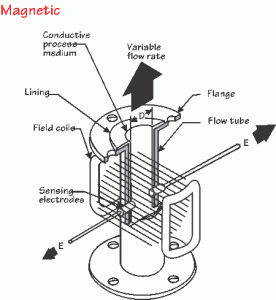
Magnetic flowmeters use Faraday’s law of electromagnetic induction. According to this principle, a voltage is generated in a conductive medium when it passes through a magnetic field. This voltage is directly proportional to the density of the magnetic field, the length of the conductor, and the velocity of the conductive medium. In Faraday’s law, these three values are multiplied together, along with a constant, to yield the magnitude of the voltage.
Magnetic flowmeters use wire coils mounted onto or outside a pipe. A voltage is then applied to these coils, generating a magnetic field inside the pipe. As the conductive liquid passes through the pipe, a voltage is generated and detected by electrodes mounted on either side of the pipe. The flowmeter uses this value to compute the flowrate.
When magnetic flowmeters were first introduced, many had coils powered by continuous alternating current (AC). These devices had the disadvantage that they were subject to noise that interfered with the proper reading of the meter. As a result, they needed to be calibrated regularly against an onsite hydraulic zero to maintain their accuracy.
Direct current (DC) magmeters were developed to solve the problems from the noise associated with AC meters. The DC meters are based on pulsed direct current. When the current is turned on, a voltage is generated in the magnetic flowmeter, showing the velocity of a flowing liquid. When the current is turned off, any remaining voltage is assumed to be due to noise. The meter computes flow velocity by subtracting this extra remaining voltage.
While DC pulsed technology was first introduced in 1974, it became popular in the 1980s, and its popularity has grown since then. Many pulsed DC magmeters have the drawback, however, of lower signal strength. This gives AC meters an advantage for measuring some dirty liquids and slurries.
To compensate for low signal strength, some DC meter suppliers developed “high strength” DC meters. These high strength meters still use the pulsed on-off technology of DC meters, but they have a higher coil current. This makes them better able to handle high noise applications — such as slurries and dirty liquids — than standard DC meters. These high-strength meters are growing rapidly in popularity.
Previous magnetic flowmeter studies
The World Market for Magnetic Flowmeters, 7th Edition (2022)
The World Market for Magnetic Flowmeters, 6th Edition (2017)
The World Market for Magnetic Flowmeters, 5th Edition (2015)
The World Market for Magnetic Flowmeters, 4th Edition (2009)
The Global Market for Magnetic Flowmeters, 3rd Edition
The World Market for Magnetic Flowmeters, 2nd Edition
The World Market for Magnetic Flowmeters, 1st Edition
Join the discussion on Flow Research’s LinkedIn group for magnetic flowmeters: linkedin.com/groups/13197555/