Larger line size — a frontier of research for Coriolis
(from New-Technology Flowmeters, a book by Dr. Jesse Yoder published in 2022 by Taylor & Francis)
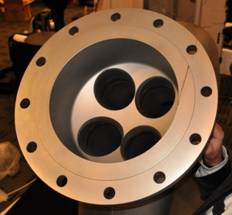
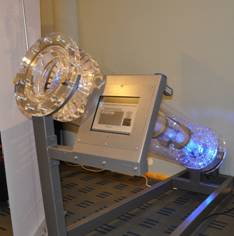
Building large and larger line size Coriolis flow meters is a frontier of research for this meter type. The largest line size currently built is a 16-inch meter built by Endress+Hauser. It is not clear why a larger Coriolis meter cannot be built, but such a meter would have to overcome several barriers:
– The meter would presumably have to be even larger and heavier than the current large line size meters. This would make it even more difficult to move around and install than existing meters. So far no one has been able to build a 20 inch meter.
– As the meter gets larger, it becomes more difficult to vibrate the meter in such a way that it can reliably indicate mass flow. This is due to the increased weight of the meter.
– Any meter that is larger than the existing meters would be even more expensive than the existing line size meters, some at which sell for $75,000. End-users would likely look for an alternative technology such as ultrasonic or turbine if these other meters could satisfy their needs for considerably less cost.
One possible way this problem can be approached is by using even lighter materials of construction for the flowtubes. This would facilitate the vibration of the meter and also make it lighter. Coriolis flowmeters are a relatively recent entrant into the market. Although the roots of today’s Coriolis flowmeters can be traced back to the 1950s, it was not until 1977 that Micro Motion introduced a commercially viable Coriolis flowmeter for industrial applications. Since that time, a number of other suppliers have entered the market, including Endress+Hauser and KROHNE.
The principle underlying the Coriolis flowmeter, however, dates back to 1835, when French mathematician Gustave Coriolis showed that an inertial force needs to be taken into account when describing the motion of bodies in a rotating frame of reference. A hypothetical object thrown from the North Pole to the equator, for example, appears to vary from its intended path due to the earth’s rotation — and this illustrates the Coriolis force.
Why measure mass flow?
While in many cases volumetric flow is sufficient, it is also desirable at times to measure mass flow. Many products are sold by weight rather than by volume, and in these cases it is often desirable to measure mass flow. Chemical reactions are often based on mass rather than volume, so mass flow measurement is often required in the chemical industry.
While both volumetric and mass flow apply to liquids and gases, mass flow is especially appropriate for measuring gases. This is because gases are much more affected by temperature and pressure than are liquids. Pressure has minimal effect on liquids in terms of compressibility and is often ignored in making volumetric measurements of flow. The effects of temperature on liquids are also often disregarded, except where high accuracy is desired.
Operating principle
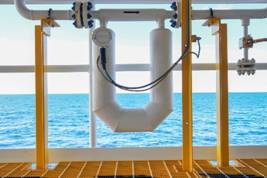
Modern Coriolis flowmeters today typically consist of one or two vibrating tubes with an inlet and an outlet. These tubes can either be straight or bent, though the large majority are bent. Whether they are single or dual, bent or straight, Coriolis flowmeters rely on oscillating tubes. The tubes are made to oscillate at their natural resonant frequency by an electromagnetic exciter or drive coil located at the apex of the tubes. The apex is the highest point of the tube, and it is where the inlet ends, and the outlet begins. Another way of describing the apex is that it is the central point between the beginning of the tube and the end of the tube.
The peak amplitude of vibration is at the apex of the flow tube or tubes. Magnet and coil assemblies called pickoffs are mounted at the same corresponding place on the inlet and the outlet portions of the flow tube(s). As the tubes oscillate, the voltage generated from each pickoff creates a sine wave. When there is no flow, the inlet and outlet sine waves are in phase. Being in phase means that they are in a synchronized motion.
The peak amplitude of vibration is at the apex of the flow tube or tubes. Coriolis flowmeters have a pickoff coil on the inlet side and the outlet side of the flow tube. The pickoff contains a coil and a magnet. As the coil moves through the magnetic field from the vibration of the tubes, voltage is produced. This voltage can be represented as a sine wave.
When fluid is not moving through the tube, the inlet and outlet sine waves are in phase. Being in phase means that they are in a synchronized motion. This means that the waves are moving at the same rate and exactly together. When two people synchronize their watches, they set them to the same time so that the watches are moving together, and both tell the same time. Under no flow conditions, the size waves generated by the pickoffs on the inlet and outlet side look exactly the same.
When fluid moves through the tube, the inertial force of the fluid causes the tube to oscillating. This results in a phase shift, or time difference, between the sine waves on the inlet side of the tube and the sine waves on the outlet side of the tube. The sine waves generated by the pickoff coils on the inlet and outlet side of the tube are no longer in phase; instead, they are asynchronous. There is now a difference in time between these sine waves, which is measured in microseconds. This difference in time is called delta t. Delta t is directly proportional to mass flowrate. The mass flowrate is computed by the transmitter, which outputs this value along with other desired values such as density, volumetric flow, and temperature.
While the amount of the phase shift or delta t is directly proportional to mass flowrate, the sine wave frequency indicates density. Frequency means the number of waves per second. A heavy fluid like honey will have a lower frequency than a lighter liquid such as water. Some Coriolis meters are used to measure density rather than flow, but generally both values are desired.
Coriolis flowmeter design
Coriolis flowmeters contain one or more vibrating tubes. These tubes are usually bent, although straight-tube meters are also available. The fluid to be measured passes through the vibrating tubes. It accelerates as it flows toward the maximum vibration point and slows down as it leaves that point. This causes the tubes to twist. The amount of twisting is directly proportional to mass flow. Position sensors detect tube positions.
Coriolis suppliers have introduced a wide variety of models and types of Coriolis flowmeters in the past 35+ years and differentiate themselves in a number of ways. One is by the proprietary design of the bent tubes. Another is by the different types of straight tube Coriolis flowmeters they offer.
Suppliers also compete by bringing out Coriolis flowmeters for particular industries and applications, such as food & beverage and pharmaceutical. Accuracy and other performance specifications are other areas of supplier differentiation.
While Coriolis flowmeters are loved by many end users, price is often an issue. Coriolis flowmeters are the most expensive meter made, in terms of average selling price. The average selling price of Coriolis flowmeters are between $5,000 and $6,000. Some suppliers have introduced low-cost Coriolis flowmeters in the $3,000 range. Performance specifications for the lower-cost flowmeters are not at the same level as those of the higher-priced meters. However, these lower-cost meters can help satisfy the needs of users who want the essential benefits of Coriolis technology but prefer not to pay the higher price.
Coriolis flowmeters are used to measure both liquids and gases, but they do have some limitations with gas flows. Coriolis meters have an easier time measuring liquids than gases because liquids are denser than gases.
|